Let’s delve into the world of sprouted grains. What are they? Are they better for you? Can I eat them?
Make it Grow!
Have you heard the term sprouted grain and been curious what it is? Let’s learn about the beauty of sprouted grains and if they could be beneficial for you and yours!
Sprouting a grain is just encouraging the grain to grow, like you would for a garden. You put the grain in a moist environment until it begins to sprout. A sprouted grain will eventually turn into a new plant if you let it continue to grow.
However in this case, once the grain starts to sprout, it is removed from the moist environment and then dried. Once the grain is completely dried it can be ground into flour or rolled or left whole.

Why do it?
Why bother with buying or making sprouted grains? Sprouting a grain can aid in digestion. The process of sprouting helps break down the starches in the grain as well as neutralize enzyme inhibitors so our bodies can actually absorb the nutrients in the grain.
I like to think that sprouting turns the grain into a vegetable. That’s a very simple way of explaining it and maybe not very scientific but it helps my brain understand.
Personally, sprouted grains don’t bother my kids as much, so that’s my reason for using them. Find your reason. Is it worth it or necessary for your family?

Do it Yourself
I have made my own sprouted grains. It takes a few days of hands off time. It is not complicated or tricky, nor does it require much equipment (a quart size mason jar and a sprouting lid (this is the one I have and I love it)). Sprouting just takes a little bit of mental space. If you want to sprout your own grains here are the 7 steps.
- Rinse and drain 1 cup of grains. Remove any debris or foreign objects.
- Place the grains in a clean quart size jar and cover with water. Cover with your sprouting lid or a paper towel and a rubber band and let sit in the water on the counter for 12 hours.
- After 12 hours, drain the grains in a strainer or colander or through your sprouting lid. Add clean fresh water to the jar, swirl around the grains and then drain again.
- Turn the jar upside down and at an angle so that excess water can drain and air can circulate (see picture above).These sprouting lids that I have, include a little stand that holds the jar at the perfect angle. I set the jar on a little plate to catch extra water. Keep it out of direct light and at a temperature below 78 degrees.
- Every 12 hours until sprouted, add clean, fresh water into the jar and swirl it to rinse all the grains. Pour off the excess water and repeat step number 4 again.
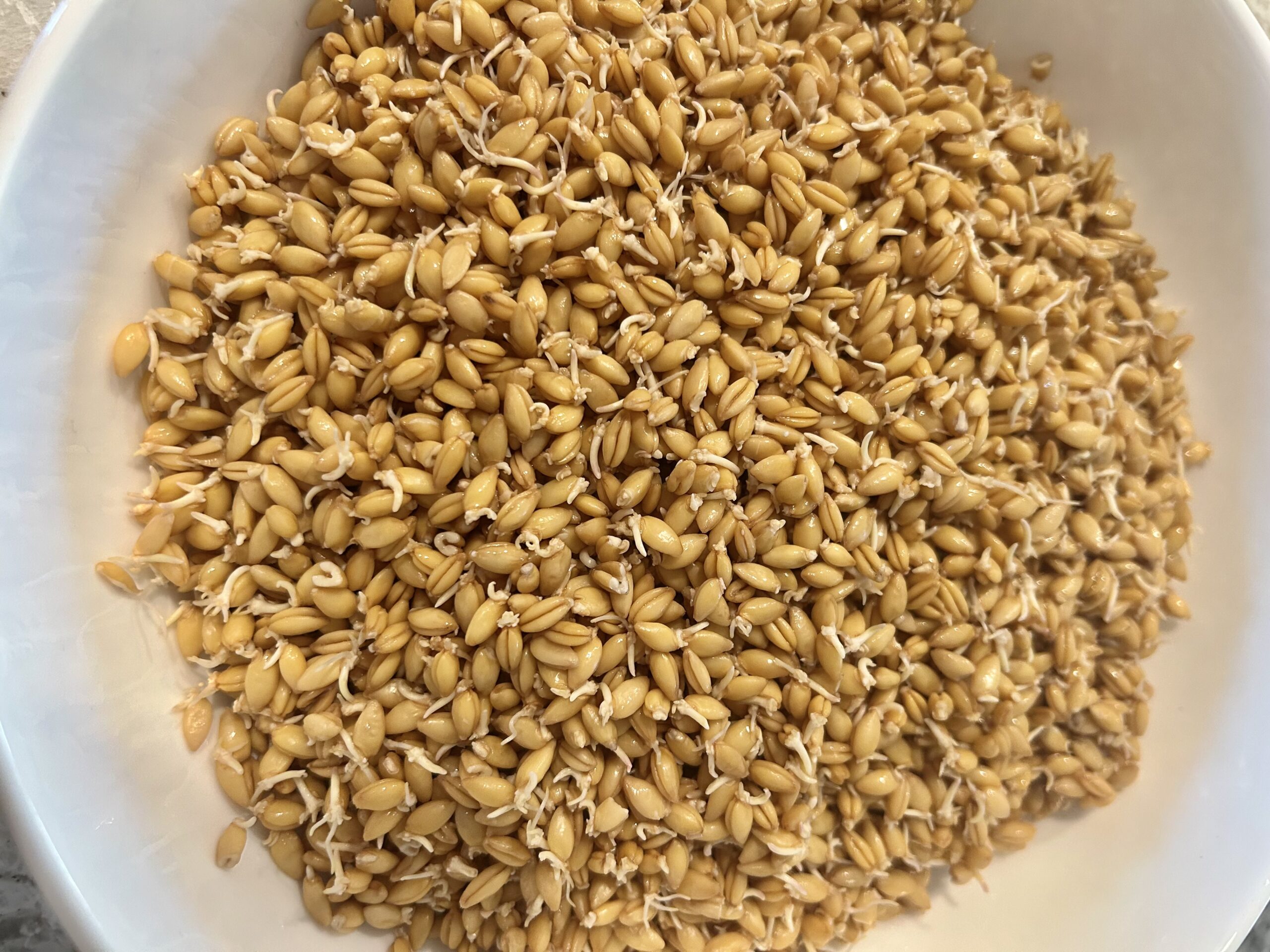
- The grains should sprout within 1 to 5 days. You will know they are ready when they have little white tails peeping out. You can let that “tail” grow up to 1/4 inch long.
- You can use them as is, in salads or toppings. They can be boiled as well for a softer texture or you can dry them out and grind them into flour.

Or Buy Them
If sprouting your own grains sounds overwhelming or time consuming or annoying or whatever else you think, there are other options.
Fortunately these days, there are companies now that sprout grains for us! They are more expensive than doing it yourself but that might be better for you than taking the time to learn and do it.
I like One Degree sprouted products. Most often I buy their whole grain sprouted spelt flour, sprouted rolled oats and the sprouted quick oats. I can find them at Sprouts (I have also seen sprouted whole wheat flour, kamut flour and sprouted cereals and granolas), Costco (only the rolled oats) or Azure Standard.
Other companies also make sprouted products. I have seen sprouted flour pretzels and crackers. Sprouted bread products such as tortillas, buns and bagels. There are also sprouted pastas.

How to use Sprouted Grains
Using sprouted grains is not tricky. In fact, you use them mostly just the same as you use any other whole grain products.
When cooking the whole berry, it will cook through in about half the time. For example, a whole grain einkorn berry boils to a nice texture in about 35 minutes. A sprouted einkorn berry will take about 15-18 minutes.
With the sprouted oats, I find they are a little thicker than their unsprouted counterpart but that hasn’t affected my recipes in any way.
Sprouted grains in their flour form can be substituted 1:1 in any recipe. I haven’t found that I have to change my recipes much at all when using sprouted flour. They are a little more thirsty than their non-sprouted counterpart and so every once in a while I have to increase the moisture in the recipe by a tablespoon or two.
However you use un-sprouted grains, you can use sprouted grains. Use them. See how they make you feel. See if they make a difference with intolerances or digestive discomfort. If they do, awesome! If they don’t, that’s ok. You learned something new. Welcome to the world of sprouted grains!